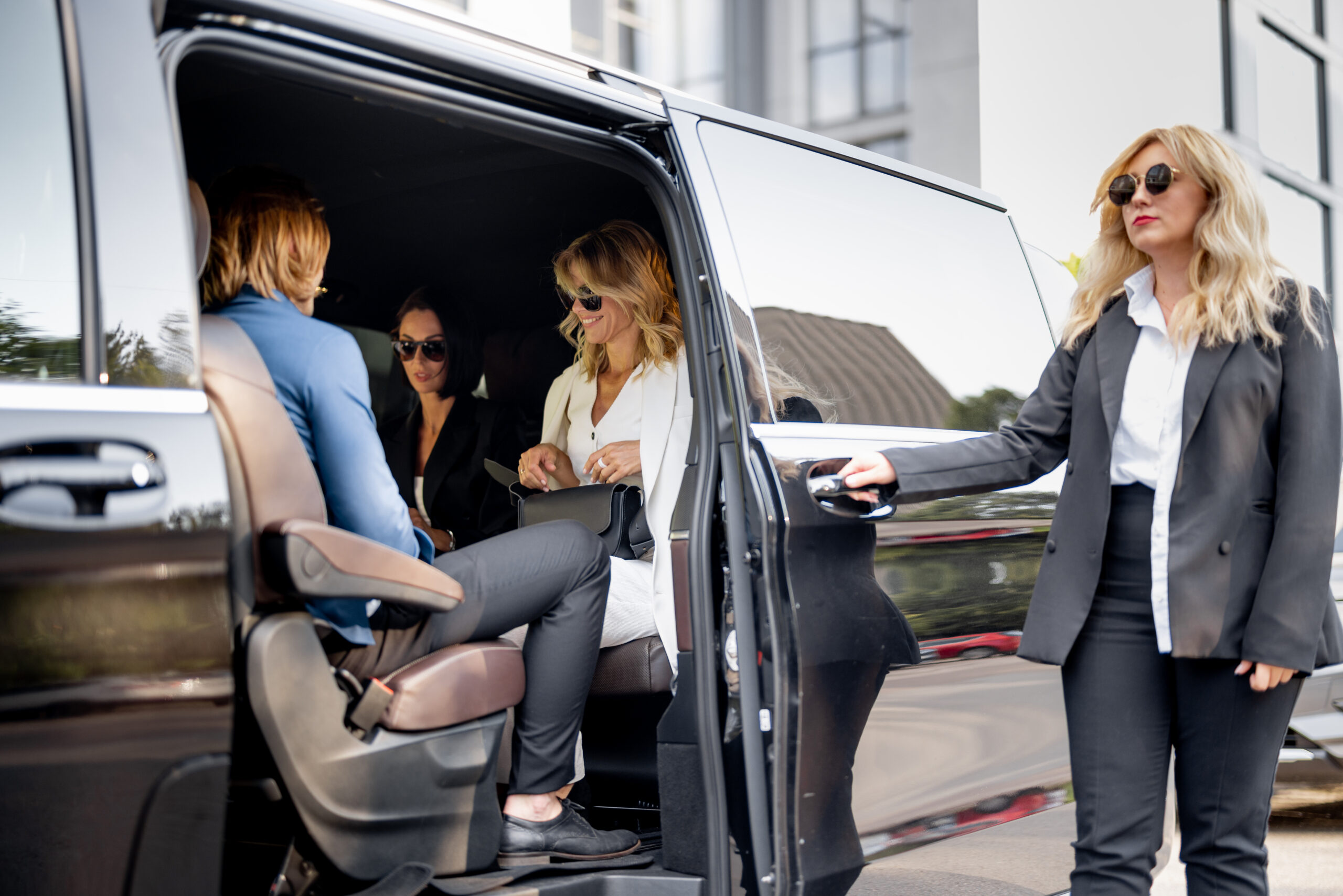
Anyone organizing group transport in Lucerne for an event is dealing with two very different tasks. Getting guests to the venue is one. Getting them home or back to their hotel afterwards is the other. The two follow completely different patterns, and recognizing that early makes planning the transport far less stressful.
This article shows what matters for both directions, and where most planning runs into trouble. The focus here isn’t the vehicle, but the sequence: who gets taken where, and when.
An event has two directions
Arrival and departure aren’t simply the same thing in reverse. On arrival, guests come one after another, from different directions and at different times. The flow spreads out over a longer period, almost by itself.
At the end of the event, that reverses. Then almost everyone wants to leave at the same time. What was a staggered arrival becomes a concentrated departure. Group transport in Lucerne for a larger group stands or falls on the return trip. That difference is exactly what makes the two directions two separate tasks that should be planned separately. Treat both the same, and you’ll almost always plan one well and the other too tightly.
Arrival: staggered, and from many directions
For arrival, guests rarely travel together. Some come from home, others from a hotel, others still from the station or the airport. Each has their own start time, and that’s exactly what makes arrival manageable, since the flow spreads out over the evening. A good rule of thumb is to set the last pickup so that even the last guest arrives in good time before the start.
Even so, arrival doesn’t quite run itself. The more guests coming from different places, the more a clear plan pays off before the first car sets off.
Set a central meeting point
A central meeting point, from which the group travels on together, simplifies a lot. That way, not everyone has to find their own way to the venue, and nobody gets lost along the way. That’s especially useful when the venue is outside the city or hard to find. Choose the meeting point so that most guests can reach it easily and without a detour.
Alternatively, guests are picked up at several points. That’s more convenient for individuals but takes more coordination in advance. Which option fits depends on the group and the starting points. For a small, scattered group, individual pickups make sense; for a large group, a shared meeting point is usually calmer.
Hotels as natural gathering points
When many guests are coming from out of town, hotels are a good starting point. Well-known addresses such as the Grand Hotel National or the Bürgenstock Resort are places where a group can gather easily, and that everyone finds without lengthy directions.
A hotel as a meeting point has a practical advantage: guests wait indoors, and the pickup happens at a fixed point. That saves back-and-forth and keeps the ride departing on time. A hotel is also a clear destination for the return trip at the end of the evening, where several guests can be dropped off. For guests coming from further away, say from the airport, the hotel is often their first and last stop of the day anyway.
The return trip: everyone at once
The end of the event is where you find out whether the transport was planned well. Within a few minutes, almost all the guests want to leave at the same time. Many separate arrivals become one concentrated departure.
Why most planning goes wrong here
The return trip is the part most often underestimated. Anyone who plans mainly with the arrival in mind ends up, at the end, facing a group that all wants to leave at once. Then vehicles are missing, or guests wait longer than expected.
The mistake is usually treating the return trip like the arrival. But it doesn’t spread out over the evening by itself. It has to be actively planned, or you end up with exactly the bottleneck you wanted to avoid. That’s why the return trip belongs in the plan at the time of booking, just as much as the arrival. A good guide is the guest count: the larger the group, the more likely you’ll need more than one ride at the same time.
How late the return window really needs to be
A second point is often overlooked. Events rarely end exactly on time. The official end isn’t the moment guests actually leave. Conversations run long, goodbyes take time, and a planned hour quickly becomes more.
Plan the return window generously, and noticeably later than the announced end. A service that’s available late into the night gives you the security you need here. That way, the return ride is ready when guests actually want to leave, not when the schedule originally said they would. Set the window too tight, and you risk exactly the wait nobody wants at the end of a good evening. When in doubt, a slightly later window is always the safer choice than one that’s too early.
What an evening with guest transport looks like
An example makes the difference tangible. In the early evening, the first guests arrive: some picked up from home, others shortly after from the hotel or the station. Spread over more than an hour, the event fills up without a crowd forming at any one point.
Late in the evening, the picture flips. When the event winds down, everyone is suddenly ready to leave at the same time. Anyone who hasn’t planned rides for this moment leaves guests waiting. Anyone who has reserved a late return window, on the other hand, gets everyone home promptly, some into the city, others to nearby communities such as Kriens, Horw, or Emmen.
Group transport in Lucerne: plan both directions together
It’s best to plan arrival and departure in one process, but as two separate tasks. For arrival, set the meeting points and start times. For the return trip, set a realistic time window with some reserve.
For an event with guest transport, it’s worth naming a contact person who can be reached on the day. That way, last-minute changes can be sorted out without disturbing the hosts themselves. When booking, state the number of guests, the locations, and both time windows, and everything falls into place. Group the guests for the return trip by direction: those heading to the same area travel together, which noticeably speeds up the departure at the end.
One last tip: let guests know the meeting point and the approximate times in advance. When everyone knows where and when the ride starts, the evening runs smoothly from the first ride to the last. A short message with the meeting point, time, and contact person is usually enough.
Your group transport for events in Lucerne
Planning an event with several guests? Luzerner Taxi handles the transport in both directions, from the staggered arrival to the return trip at the end of the evening. You set the meeting points and times, we make sure nobody waits. Whether it’s a small celebration or a larger event, the approach stays the same, well planned in both directions.
Book via the app, online, or by phone at +41 41 558 89 89 and coordinate both directions early.
Schreiben Sie einen Kommentar